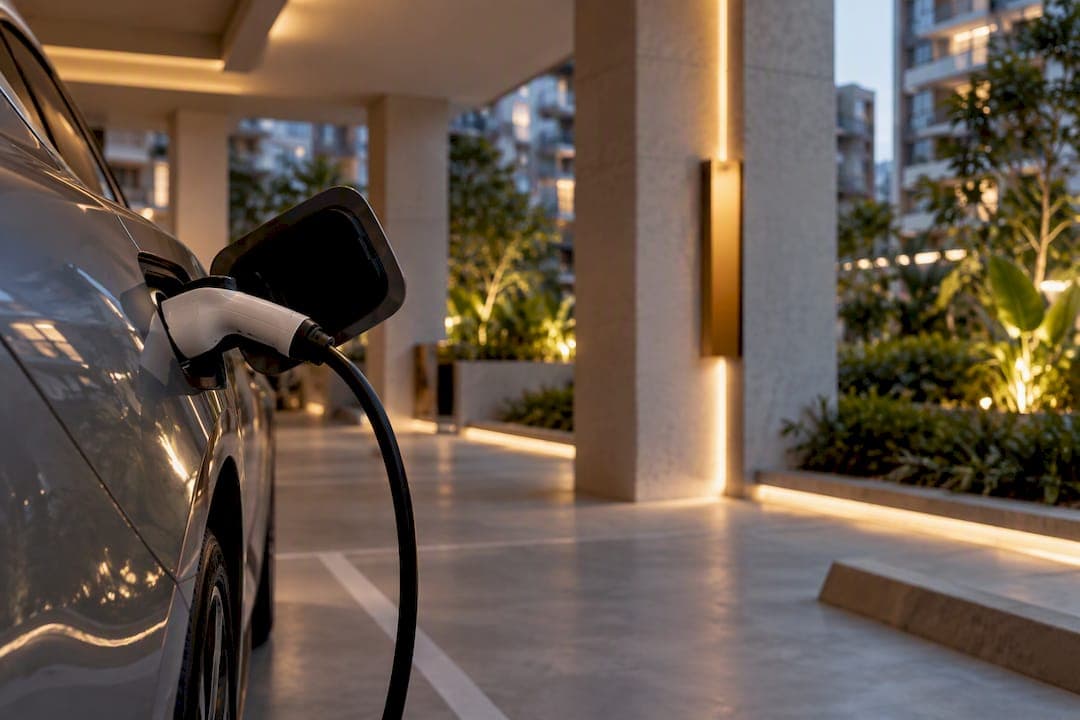
Yes: Singapore condominiums can install EV chargers, subject to LTA approval, type approval requirements, and MCST governance under the BMSMA. The Electric Vehicle Common Charger Grant can co-fund half of eligible installation costs, though quota caps apply and availability is limited. Your single next move is to commission a Licensed Electrical Worker feasibility assessment and check your ECCG eligibility before the application window closes.
TL;DR:
- The typical out-of-pocket cost for condo EV chargers will likely exceed the grant cap, especially if substantial cabling or power upgrades are needed.
- The grant application process requires prompt action within a six-month window after receiving the Letter of Offer, making early assessment critical.
- All chargers must meet Singapore's type approval, SS 722, and TR25 standards, with contractors planning for compliance upfront to avoid costly retrofits.
- MCSTs should consider ownership models carefully, ensuring the contract covers maintenance, warranties, data sharing, and liability to prevent future disputes.
- Early technical feasibility assessment and resident communication are essential to prevent delays, manage expectations, and secure smooth project approval.
Table of Contents
- Why EV charging matters for condos in Singapore
- Government funding and the ECCG: eligibility, caps, and how it works
- Regulatory and technical requirements: EVCA, type approval, SS 722, and TR25
- Practical steps for a condo: resolution, procurement, and contract checklist
- Technical feasibility checklist for engineers and MCSTs
- Typical costs, timeline, and who pays for condo charging
- Choosing an EV charging operator or installer: what to check
- Operations, maintenance, and compliance after installation
- User access and billing management systems for EV chargers in condos
- Communication strategies and resident engagement during installation
- Integration with condo energy management and sustainability goals
- A manager's account of getting one condo EV-ready
- Hougang Central Residences: built with tomorrow's infrastructure in mind
- Sources
- FAQ
Why EV charging matters for condos in Singapore
Demand for EV charging is no longer a niche request from a handful of Tesla owners. It has become a standard question buyers and tenants ask before committing to a unit. MCSTs that ignore it risk falling behind comparable developments that already offer the amenity.
The government's own trajectory makes the direction clear. Policy targets point to a large expansion of public and residential charging points by 2030, and many HDB car parks are already EV-ready as part of that push. Condominiums that lag behind this shift risk looking dated to prospective buyers who compare amenities before making an offer.
For MCSTs, the business case rests on a few practical points:
- Chargers add a visible, modern amenity that supports resale value and rental appeal in a market where EV ownership keeps expanding.
- Grant co-funding lowers the financial barrier that used to make chargers a hard sell at an AGM.
- A lower voting threshold for charger-related resolutions means fewer MCSTs get stuck at the approval stage.
- Early movers avoid a rush later, when contractor waitlists and grant quotas may tighten.
The Electric Vehicle Common Charger Grant co-funds 50% of eligible installation costs, which is often the difference between a proposal that stalls at committee and one that gets approved on the first vote.
The practical effect is that MCSTs no longer need to choose between an amenity residents want and a budget the sinking fund can absorb. The grant, paired with capex-free operator models, means many condos can add chargers without a large upfront cash call. That changes the conversation at resident meetings from "can we afford this" to "which model fits us best."
Government funding and the ECCG: eligibility, caps, and how it works
The Electric Vehicle Common Charger Grant is the single biggest lever MCSTs have to make charger installation affordable, and understanding its mechanics matters more than any other step in this process.
The grant covers half of eligible upfront costs, including charging system hardware, Licensed Electrical Worker fees, and cabling or installation work. For the remaining quota, co-funding is capped at $3,000 per charger, with a separate $1,000 sub-cap specifically for cabling and installation costs. The grant window runs until December 31, 2026, or until 3,500 chargers have been approved nationwide, whichever comes first.
The $3,000 per-charger cap and $1,000 cabling sub-cap mean a typical MCST should budget for out-of-pocket costs beyond the grant, particularly if the site needs substantial cabling work or a power upgrade.
Eligibility follows a specific structure. Non-Landed Private Residential owners (through their MCST or management corporation) or licensed Electric Vehicle Charging Operators can apply on their behalf.
The application itself runs through a defined process:
- Confirm eligibility and gather building details, including parking lot counts and an initial sense of electrical capacity.
- Submit the application through the Business Grants Portal, where LTA processes ECCG requests.
- Receive a Letter of Offer once the application is reviewed and approved.
- Complete installation within the window specified in the Letter of Offer.
- Submit claims through the same portal once installation is done and verified.
Applicants typically have six months from accepting the Letter of Offer to complete installation and submit claims, a tight window for a body corporate that still needs to coordinate contractors, LEW sign-off, and resident access.
Missing that six-month window creates real risk. Change requests are possible, but they add administrative complexity and delay, and a lapsed Letter of Offer can mean forfeiting the co-funding entirely. MCSTs that wait until the last minute to start contractor procurement often find themselves scrambling to meet a deadline that could have been comfortably met with earlier planning.

Regulatory and technical requirements: EVCA, type approval, SS 722, and TR25
Singapore's EV charging rules are built around a small set of frameworks, and any condo installation needs to satisfy all of them, not just the ones a contractor happens to mention first.
The Electric Vehicle Charging Act governs registration and operational rules for charging infrastructure. It distinguishes between restricted access chargers, typically installed for private condo use behind a gate or key fob system, and non-restricted access chargers, which are open to the public and carry additional registration obligations. Most condo installations fall into the restricted access category, which simplifies compliance but does not remove it entirely.
Type approval is mandatory for any charger installed in Singapore. This confirms the hardware meets local safety and performance standards before it goes into service. Connector standards follow a similar split: Type 2 and CCS2 connectors are the norm for public-facing infrastructure, while other connector types may apply for non-public condo installations depending on the guidance set out in TR25.
A few points MCSTs should confirm with any installer before signing a contract:
- The charger model holds valid type approval for the Singapore market.
- The installation is registered correctly under the EVCA, matching restricted or non-restricted access as applicable.
- Connector types match what current and anticipated resident vehicles actually use.
- The contractor is aware of and planning for SS 722 requirements, not just today's baseline standard.
Singapore Standard SS 722 is the newest layer in this framework. SS 722 sets updated safety and cybersecurity requirements for EV charging systems and took effect in April 2026. A transition period is in place, but MCSTs installing new chargers now should ask contractors directly whether their proposed system already meets SS 722, since retrofitting a non-compliant system later is far more expensive than specifying it correctly the first time.
TR25 rounds out the technical picture. It contains the detailed checklist and testing requirements that LEWs and inspectors use, covering functionality tests, earth loop impedance checks, and RCCB trip testing, along with recommended inspection frequencies such as every six months for non-restricted access chargers. Any MCST evaluating a contractor's proposal should ask to see how their maintenance plan maps onto the TR25 checklist, rather than taking a general assurance of "compliance" at face value.

Practical steps for a condo: resolution, procurement, and contract checklist
Getting chargers installed is as much a governance exercise as a technical one. The path runs through a resolution, a choice of ownership model, and a contract that protects the MCST for years after installation day.
Recent amendments to the Building Maintenance and Strata Management Act lowered the voting threshold for charger-related resolutions, making it easier for MCSTs to get proposals passed at an AGM or EOGM without the higher supermajority once required for infrastructure changes. That said, preparation still matters. A proposal that arrives at a general meeting without cost estimates, a grant eligibility check, and a clear ownership model tends to generate questions the committee cannot answer on the spot, which stalls the vote.
Two main ownership models dominate the condo market:
- Capex-free model: a licensed EVCO owns and maintains the chargers, and the MCST hosts the infrastructure with little or no upfront cost, often in exchange for a revenue share or subscription arrangement.
- Capex-intensive model: the MCST owns the chargers outright, applies for the ECCG itself, and takes on maintenance responsibility, generally in exchange for greater long-term control and revenue potential.
Pro Tip: Smaller MCSTs with limited management bandwidth often do better starting with a capex-free model, then revisiting ownership once resident demand and usage patterns are clearer.
Whichever model a condo chooses, the contract needs to cover specific ground. Skipping any of these items tends to surface as a dispute a year or two down the line:
- Maintenance service level agreements, including response times for faults and who covers replacement parts.
- LEW verification requirements built into the maintenance schedule, not just the initial installation.
- Type approval warranty terms that specify what happens if hardware fails compliance checks later.
- Insurance coverage for the charging equipment and any liability tied to its use.
- Data-sharing terms, particularly if the operator collects usage or billing data from residents.
- Change-of-ownership clauses covering what happens if the MCST later wants to switch operators or buy out an EVCO-owned system.
MCSTs weighing renovation-adjacent decisions, including how charger installation interacts with other estate works, may also want to review general condo renovation and governance rules before finalizing a resolution, since overlapping approvals can otherwise slow the timeline.
Technical feasibility checklist for engineers and MCSTs
Before any resolution goes to a vote, an LEW needs to confirm the building can actually support the chargers being proposed. Skipping this step is the single most common cause of stalled projects.
- Assess substation and switchroom capacity. The LEW checks whether the existing electrical supply has spare capacity for the proposed number of chargers, or whether an upgrade is needed before installation can proceed.
- Identify spare circuits and cabling routes. Older buildings often lack the spare circuits assumed in a quick sales pitch, and running new cabling through common property can add cost and time that a simple quote does not capture.
- Review parking layout against RPPS rules. Re-drawing or converting lots for charger use needs to account for Resident's Parking Permit Scheme constraints; a mismatch here can force a rework of the entire layout. Readers dealing with lot allocation questions can find more detail in guidance on RPPS and parking allocation.
- Confirm safety protections are in place. Wheel stops, bollards, and adequate clearance around charging bays reduce the risk of accidental damage to cabling and connectors.
- Decide on charger power output. LTA guidance for MCSTs suggests starting with lower-powered chargers, around 7.4 kW, which suit overnight resident charging without straining the building's electrical capacity, and scaling up as demand grows rather than over-specifying from day one.
Older condominiums in particular tend to run into capacity constraints that only surface once an LEW actually inspects the switchroom. A building that looks straightforward on paper can still need a substation upgrade once the assessment is done, and that single finding is often what separates a smooth six-month installation from a project that drags into a second year.
Typical costs, timeline, and who pays for condo charging
Budgeting for EV chargers means separating what the grant covers from what the MCST will still need to fund out of the sinking fund or a special levy.
The ECCG reimburses charger hardware, LEW assessment fees, and cabling costs up to the sub-cap.
A realistic timeline runs in four broad phases:
- Feasibility survey and LEW assessment, typically the first step before any grant application is submitted.
- Letter of Offer issued by LTA once the ECCG application is approved.
- Installation completed within the window set out in the Letter of Offer.
- Claim submission through the Business Grants Portal once installation and verification are complete.
Applicants generally have six months from Letter of Offer acceptance to finish installation and submit claims, which is why an early feasibility survey matters more than it might seem at first glance.
Beyond the initial installation, MCSTs should plan for recurring annual costs: routine maintenance and inspections tied to the TR25 schedule, electricity consumption for the chargers themselves (often billed separately to users), and any software subscription fees tied to access control or billing platforms. Some operator models offset part of this through a revenue share on usage fees, which is worth negotiating into the contract rather than treating as a fixed cost.
Choosing an EV charging operator or installer: what to check
Selecting a competent installer matters as much as the technical spec sheet, since a poorly run operator can turn a well-designed system into a maintenance headache.
Start with licensing. If the operator plans to run a public-facing or subscription-based service, confirm they hold a valid EVCO license rather than taking their word for it. Ask directly about their experience with type approval processes and whether their proposed hardware already accounts for SS 722 and TR25 requirements, since a contractor unfamiliar with these frameworks is more likely to deliver a system that needs costly rework later.
A shortlist worth running through before signing anything:
- Confirm the operator's EVCO license status if they will bill residents or operate publicly accessible chargers.
- Ask for evidence of past type approval compliance and familiarity with TR25 inspection checklists.
- Compare access control options: key fob, app-based booking, or open access, and how each handles resident-only restrictions.
- Review billing and metering approaches, including whether usage is billed per session, per kWh, or through a flat subscription.
- Ask about uptime guarantees and what remedy applies if chargers are down for extended periods.
- Confirm cybersecurity practices align with SS 722 expectations rather than an older baseline.
On the procurement side, ask for a completed LEW assessment as part of any proposal, request references from other Non-Landed Private Residential properties the operator has serviced, and get warranty and change request terms in writing before the resolution goes to a vote. A vendor unwilling to provide references from comparable condo properties is a warning sign worth taking seriously.
Operations, maintenance, and compliance after installation
Getting chargers installed is not the end of the MCST's responsibilities. Ongoing compliance and maintenance determine whether the system stays reliable for years rather than becoming a recurring source of complaints.
TR25 recommends specific inspection cadences, generally every six months for non-restricted access chargers, and the LEW who signed off on installation typically plays a continuing role in periodic verification rather than a one-time check. MCSTs should build this cadence into their annual maintenance budget rather than treating it as an optional extra.
Key ongoing obligations include:
- Scheduling periodic inspections in line with TR25 recommendations and keeping records of each check.
- Updating LTA registration details if ownership or operational arrangements change, such as switching from one EVCO to another.
- Setting clear resident policies covering charger allocation, booking procedures, and how faults get reported.
- Establishing an incident response process for equipment failures, electrical faults, or safety concerns.
A management committee that treats these as administrative afterthoughts tends to see complaints pile up quickly, since residents notice fast when a charger is broken and nobody seems responsible for fixing it. Building a simple fault-reporting channel, even something as basic as a dedicated email address or app form, prevents most of these frustrations from escalating into committee disputes.
User access and billing management systems for EV chargers in condos
Once chargers are installed, the MCST needs a working system for who gets access and how usage gets billed. Most condo deployments use one of a few common approaches: RFID key fobs tied to individual units, app-based booking systems that let residents reserve a charging slot in advance, or open access systems that simply track usage by session.
Billing models vary by operator and ownership structure. Some condos charge per session at a flat rate, others meter by kWh consumed, and capex-free arrangements often route billing directly through the operator's own app rather than through the MCST's management office. Whichever model a condo picks, transparency matters: residents want to see clearly what they are being charged and why, and disputes over billing are one of the most common sources of complaints once chargers go live.
MCSTs should also decide early who is responsible for enforcement, such as what happens if a resident occupies a charging bay without actually charging, since parking etiquette issues around EV bays tend to surface within weeks of installation. Building this into the access system from the start, rather than trying to retrofit rules later, avoids a lot of friction.
Communication strategies and resident engagement during installation
Installing EV chargers touches common property, which means residents notice the disruption even if they never plan to own an EV themselves. Clear, early communication reduces friction significantly.
A simple approach works best: notify residents well ahead of installation dates, explain which parking areas will be affected and for how long, and give a realistic sense of the disruption involved, whether that means temporary parking lot closures or brief power interruptions during electrical work. Posting updates in the same channels residents already check, whether that's a WhatsApp group, a noticeboard, or a management portal, keeps the process visible rather than something residents hear about only when the work crew shows up.
It also helps to frame the proposal in terms residents can weigh for themselves at the AGM stage. Presenting the grant co-funding, the chosen ownership model, and a clear cost breakdown up front tends to generate a smoother vote than a vague pitch about "future-proofing" the estate. Residents who understand exactly what they are approving, and what it will cost them individually if a special levy is involved, are far more likely to support the resolution the first time it comes up rather than sending it back for revision.
Integration with condo energy management and sustainability goals
EV chargers do not operate in isolation from the rest of a condo's electrical system, and MCSTs increasingly think about them as part of a broader sustainability plan rather than a standalone amenity.
Smart charging systems that manage load during peak hours can reduce strain on shared electrical infrastructure, spreading charging sessions overnight when demand elsewhere in the building is lower. Some management corporations pair charger rollouts with other efficiency measures already under discussion, such as solar panel installations on common property or upgraded lighting systems, treating the charger project as one piece of a wider energy strategy rather than a one-off request.
For newer developments built with smart-home systems already in place, integrating charger data into existing building management platforms is generally more straightforward than retrofitting an older estate, since the wiring and monitoring infrastructure often already anticipates future load additions. That difference is worth factoring into any long-term capital planning discussion, particularly for MCSTs weighing whether to expand beyond their initial charger quota in future years.
A manager's account of getting one condo EV-ready
A management committee I worked alongside started where most do: a handful of resident requests at successive AGMs, followed by a proposal that finally made it onto the agenda with real numbers attached.
The first real step was commissioning an LEW to survey the switchroom, which turned up spare capacity for four chargers without a substation upgrade, a relief given the building's age. The ECCG application followed once that assessment came back, and the committee chose a capex-free model with a licensed operator to avoid a special levy, given hesitance from residents who did not own EVs.
The one lesson that stood out: timing the resident vote around the ECCG's Letter of Offer window mattered more than any technical detail. The committee nearly let the six-month installation clock run out while finalizing contractor selection, a delay caused entirely by scheduling a second EOGM rather than resolving contract terms at the first one. Building slack into the timeline before applying, not after, would have saved weeks of avoidable stress.
— Simon
Hougang Central Residences: built with tomorrow's infrastructure in mind
Retrofitting an older condo for EV charging takes planning, an LEW assessment, and patience with the grant process. A newer development sidesteps much of that friction by building modern infrastructure in from the start.
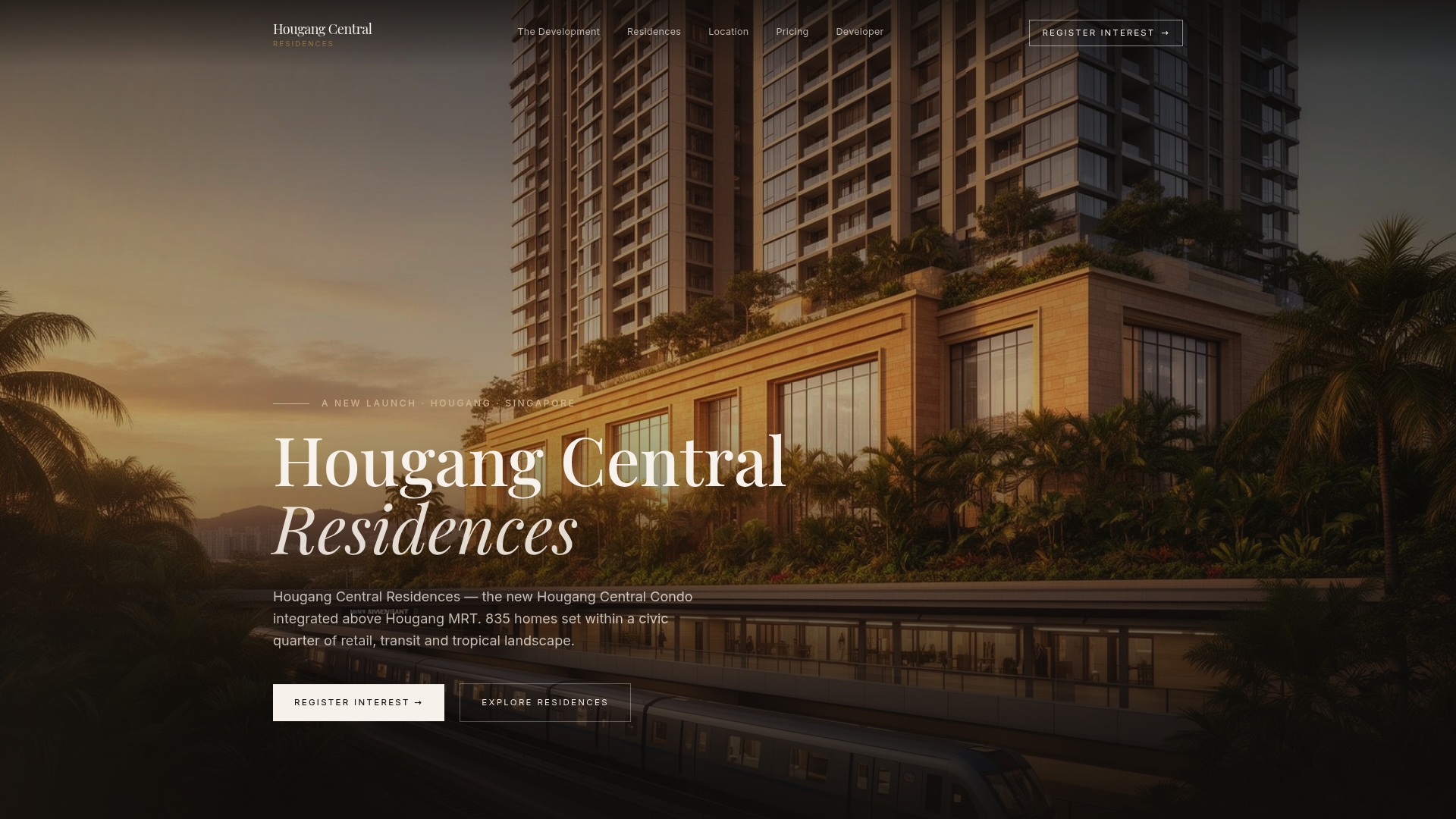
This new development integrates smart-home systems throughout the residences, with a range of unit types, alongside direct access to a major MRT station and planned future interchange. If EV readiness matters to your household, it is worth asking directly about charging provisions when you inquire, rather than assuming any particular feature. Explore pricing and unit options or browse the full range of residences to find a layout that fits your household, and reach out through the project's enquiry channels for current availability.
Sources
Start with the LTA's ECCG grant page for eligibility and caps, then the step-by-step application guide for the Business Grants Portal process. For technical compliance, review the TR25 checklist annex and the MOT announcement on SS 722. For operator options, SP Mobility's condo charging page outlines deployment models available to MCSTs today.
- LTA — Electric vehicle charger grant information
FAQ
Can I install an EV charger at my condominium?
Yes, subject to LTA registration and type approval requirements, plus MCST approval through a resolution at an AGM or EOGM. The Electric Vehicle Common Charger Grant can co-fund half of eligible installation costs, making the process more affordable than it once was.
Where can I charge my EV for free in Singapore?
Free charging is not standard in Singapore condos, though some newer installations offer promotional periods or bundled charging as part of a resident amenity package. Most condo and public chargers bill by session or by kWh consumed, so check with your MCST or the property's charging operator for current rates.
How can I charge my EV if I live in an apartment without a private charger?
If your condo has not yet installed chargers, raise the request with your MCST and point them toward the ECCG grant program, which co-funds installation costs and can make a resolution easier to pass. In the meantime, public charging points operated by providers like SP Mobility offer an alternative while your building's own infrastructure is being planned.
Who decides whether a condo can install EV chargers?
The Management Corporation Strata Title body decides through a formal resolution voted on at a general meeting, with recent BMSMA amendments lowering the threshold needed to pass charger-related proposals. An LEW feasibility assessment typically precedes the vote to confirm the building can support the proposed installation.
What does the ECCG grant actually cover?
The ECCG covers 50% of eligible costs including charger hardware, Licensed Electrical Worker fees, and cabling, up to a $3,000 per-charger cap for the remaining quota and a $1,000 sub-cap specifically for cabling. The grant remains available until December 31, 2026, or until 3,500 chargers are approved, whichever happens first.