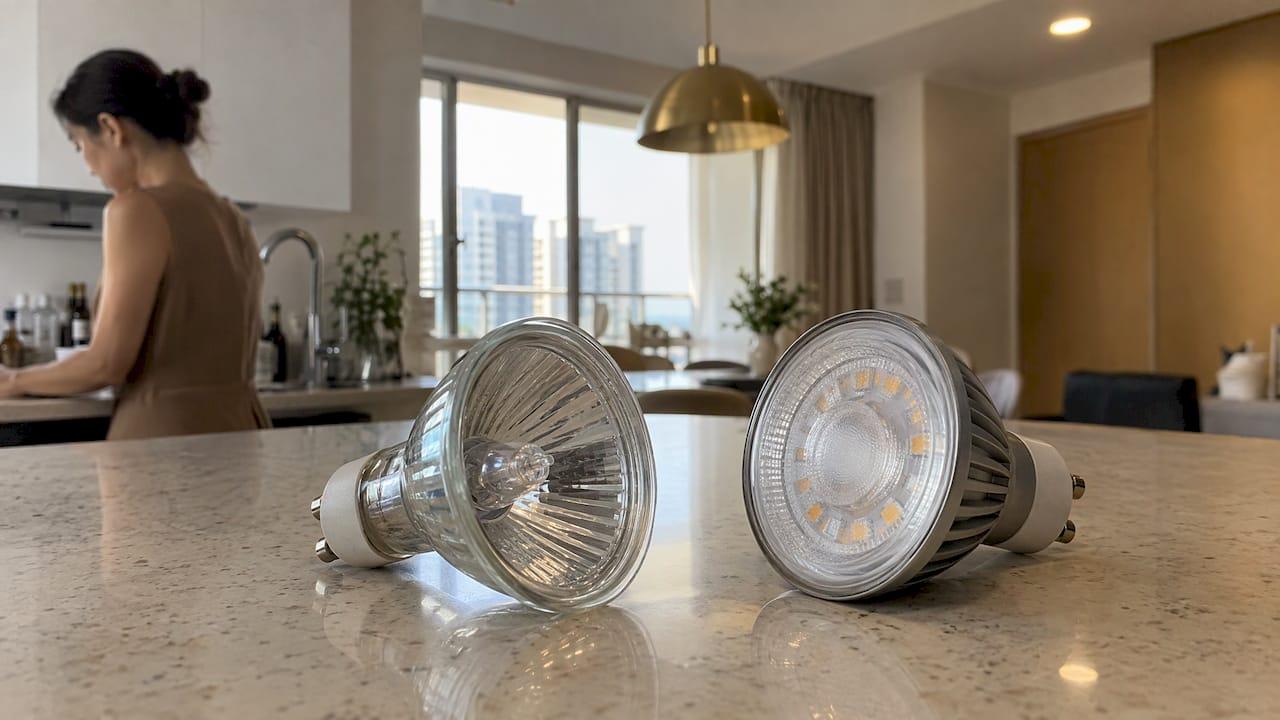
For a Singapore home, LED is the better choice in almost every room: it gives the same brightness as halogen on a fraction of the power, lasts many times longer and throws far less heat into an air-conditioned space. Halogen still has a few strengths, mainly a warm, continuous light and simple dimming on older switches. This guide shows how to compare the two properly, what the numbers mean on your bill, and what to check before swapping bulbs in an existing fitting. It also covers what to look for when you plan the lighting of a new apartment, such as a unit at Hougang Central Residences.
TL;DR
- LED uses roughly 80 per cent less electricity than incandescent lighting and about 40 per cent less than fluorescent, according to Singapore's National Environment Agency (NEA). Halogen is a type of incandescent lamp, so it sits at the wasteful end.
- Compare brightness in lumens, not watts. A typical 8–10W LED gives about 800 lm, close to a 42–50W halogen.
- Rated life is about 15,000–25,000 hours for LED against 2,000–5,000 hours for halogen.
- Check the NEA Energy Label, the voltage (230 V, 50 Hz) and, for dimmers or 12V spotlights, compatibility before you buy.
- Halogen runs much hotter, which matters in small rooms, near curtains and in homes where the aircon is already working hard.
Table of Contents
- How each bulb makes light
- Brightness: compare lumens, not watts
- Light quality: colour rendering and beam
- Energy use and running cost in Singapore
- Lifespan and replacement cost
- Heat and safety
- Can you put an LED in a halogen fitting?
- What to check in Singapore: the Energy Label
- LED vs halogen at a glance
- Lighting when you choose a new home
- Our view on lighting a modern flat
- A home above the MRT
- FAQ
- Sources
How each bulb makes light
A halogen bulb is an improved incandescent. A tungsten filament is heated until it glows, and a halogen gas inside the capsule lets it run hotter and brighter than an old-style bulb. Most of the energy leaves as heat, not light. That is why a halogen spotlight is too hot to touch a minute after you switch it off.
An LED (light-emitting diode) makes light in a small semiconductor chip. There is no glowing filament, so far less energy turns into heat. The chip still needs a small driver circuit, and it still gets warm at its base, which is why the quality of that heat management decides how long an LED lasts.
This difference drives every other comparison below: efficiency, running cost, lifespan, heat and even the shape of the light beam.
Brightness: compare lumens, not watts
For decades we judged a bulb by its wattage. A 50W halogen was bright, a 20W one was dim. That shortcut only worked because all those bulbs were equally inefficient. It breaks the moment you compare technologies.
Watts measure the power a bulb draws. Lumens (lm) measure the visible light it gives out. Australia's national energy rating programme advises that when replacing a halogen or incandescent lamp with an LED, you compare lumens, and that higher lumens mean brighter light.
As a rule of thumb, a typical 8–10W LED gives about 800 lm, similar to a 42–50W halogen. So if your old halogen downlight was around 50W, look for an LED that states roughly 800 lm on the box, not one that states 50W.
A quick way to match brightness
- Find the lumen figure on the old halogen's packaging, or its wattage if the box is gone.
- Pick an LED with a similar or slightly higher lumen figure.
- Match the beam angle (narrow for accent lighting, wide for general light) and the fitting type.
- Match the colour temperature, so the room does not suddenly turn blue-white.
That last step trips up many buyers. Halogen sits at a warm yellow-white. LEDs come in warm white, neutral and cool daylight versions. If you want the cosy feel of halogen, choose a warm white LED, typically labelled around 2700K to 3000K.
Light quality: colour rendering and beam
Halogen has one genuine advantage: it produces a continuous spectrum, so colours look natural. LEDs have caught up, but only the good ones. The measure is the colour rendering index (CRI), a score out of 100 for how faithfully a light shows colours. Designers also look at colour rendering, dimmability and the direction of the light output, each of which can change how a room feels.
Practical guidance for a home:
- Living and dining rooms: warm white, a high CRI (90 or above where you can find it) and a dimmable model.
- Kitchens and study corners: neutral white for clearer visibility, still with a good CRI so food and skin tones look right.
- Wardrobes and bathrooms: a high CRI matters most where you judge colours, such as clothes and makeup.
On direction, a halogen spotlight scatters light and relies on a reflector. An LED can be built to aim light where you want it, which reduces wasted light and glare. That helps in long, narrow rooms and in open-plan layouts where one fitting serves several zones.
Light also interacts with what is around it. The way daylight is filtered by windows, shutters and blinds changes what artificial light you need after dusk and how glare behaves on screens. If you are weighing up the daytime side of the equation, window tinting versus blinds shows how window treatments change the feel and function of a room.
Energy use and running cost in Singapore
The NEA has stated that LED lights use about 80 per cent less electricity than incandescent lights and 40 per cent less than compact and linear fluorescent lights. Halogen falls in the incandescent family, so the saving when you switch is large.
A Singapore government consultation on lamp standards estimated that an LED lamp can save a household about $14 for every thousand hours of operation. That figure dates from 2015 and depends on the tariff and the bulb replaced, so treat it as an order of magnitude. Your own saving is easy to work out with your latest utility bill:
Cost per hour = bulb watts ÷ 1,000 × your tariff per kWh
A worked example
Take a living room with six downlights on for five hours a night. With 50W halogens that is 300W, or 1.5 kWh a night. With 8W LEDs of similar brightness it is 48W, or 0.24 kWh a night. The LED setup uses about 84 per cent less energy for the same light. Multiply the difference of 1.26 kWh by 365 nights and you get roughly 460 kWh a year saved in that one room, which you can price at the tariff on your own bill. Because tariffs are revised regularly, use your latest bill rather than a figure from an article.

There is a second saving that is easy to miss in a tropical city. Every watt a halogen wastes as heat is a watt your air-conditioner has to remove. Cooler lighting helps your cooling bill as well as your lighting bill.
Lifespan and replacement cost
The rated life of an LED bulb is typically 15,000–25,000 hours, against 2,000–5,000 hours for a halogen. At five hours a day, 2,000 hours is about 13 months, while 20,000 hours is more than 10 years.
An LED bulb usually costs more to buy than a halogen. Across its life, though, you buy it once where you might buy several halogens, and you also avoid the nuisance of climbing up to replace a dead bulb in a high ceiling. Rated hours are a manufacturer's estimate, and they hold up best when the bulb is in a fitting that lets heat escape and is run on a compatible dimmer or driver.
Heat and safety
Heat is where halogen is least suited to a modern flat. Excessive heat shortens bulb lifespan and poses fire risks, and halogens run hot by design. Keep them away from fabric, paper and low shelves. LEDs emit low radiated heat, which makes them a sensible option for heat-sensitive spaces such as wardrobes, display shelves, and rooms under low ceilings.
A few practical safety points for any bulb swap:
- Switch off at the isolator or breaker before changing any bulb with exposed fittings. Let a halogen cool first.
- Never fit a bulb whose wattage exceeds what the fitting is rated for.
- Do not touch a halogen capsule with bare fingers: skin oils can shorten its life.
- For anything involving the wiring, transformers or drivers, use a licensed electrical worker.
Can you put an LED in a halogen fitting?
Often yes, but it depends on the fitting type.
Mains spotlights (GU10, 230V). These can usually be swapped directly for an LED of the same cap. GU10 halogens can be swapped directly for LED GU10s.
Low-voltage spotlights (MR16, 12V). These run through a transformer. The same source notes that many halogen transformers will not run a small LED load without flicker, because the transformer expects a minimum load. If the LED load is below that minimum, the fix is a 12V LED driver or converting the fitting, which is a job for a licensed electrician.
Dimmers. Halogens dim on standard dimmers. With LEDs, only bulbs labelled dimmable work with a compatible dimmer. If lights flicker or buzz at low settings, the bulb and dimmer are mismatched. The fix is usually a dimmer made for LED loads.
Enclosed fittings. Sealed glass shades trap heat. Choose an LED rated for enclosed use.
A simple checklist before you buy:
- Cap type (GU10, MR16, E27, B22) and voltage.
- Lumens, beam angle and colour temperature.
- Dimmable label, if the circuit has a dimmer.
- Enclosed-fitting rating, if relevant.
- NEA Energy Label (next section).
What to check in Singapore: the Energy Label
Singapore regulates household lamps. The NEA's Mandatory Energy Labelling Scheme for general lighting took effect on 1 July 2015, and the agency tells consumers to buy only NEA-registered products and to look for the Energy Label in shops and on online platforms.
When shopping, look for the label on the packaging, choose a higher tick rating (more ticks mean better efficiency; 3 to 4 ticks is a good target), and confirm the bulb is rated for Singapore's 230 V, 50 Hz supply. Bulbs without a label or with unclear ratings are best left on the shelf.
LED vs halogen at a glance
| Factor | LED | Halogen |
|---|---|---|
| Typical power for about 800 lm | 8–10W | 42–50W |
| Rated life | 15,000–25,000 hours | 2,000–5,000 hours |
| Heat | Low radiated heat | Very hot |
| Dimming | Needs a dimmable bulb and compatible dimmer | Works on standard dimmers |
| Colour | Varies, choose high CRI | Natural, continuous spectrum |
| Purchase price | Usually higher | Usually lower |
| Overall cost | Lower over time | Higher over time |
Lighting when you choose a new home
If you are buying a new apartment, lighting is one of the cheapest ways to shape how it feels, and one of the most overlooked. Plan it room by room: ambient light for general use, task light where you cook, read or work, and accent light for features. Ask about ceiling heights, the position of light points and which circuits will carry dimmers, because moving them later means work in finished ceilings.
A useful habit is to walk through a unit at different times of day. Notice where daylight falls, where glare shows on a screen and where you would want a lamp at night. That tells you more than a spec sheet. The most efficient lamp is still the one switched off when no one is using it, so think about where switches sit and whether you can zone a room.
Our view on lighting a modern flat
At Hougang Central Residences we think about a home the way a family lives in it: from morning light to late-evening wind-down. A condominium with 835 residences, ranging from 1-bedroom plus study to 5-bedroom penthouses, serves very different routines, and lighting is where those routines show.
Our homes are designed with smart-home systems and premium European fittings, and that pairing is why lighting choices matter. Controllable, efficient lighting suits a connected home, and the low heat of LED suits a tropical climate where cooling already takes a large share of household energy.
Our advice is simple. Choose LED, compare lumens rather than watts, pick warm white for living areas, and look for the NEA Energy Label. A home above Hougang MRT, with the mall and bus interchange at your doorstep, is built to save you time every day. Efficient lighting is one more way to save energy at home.
Simon
A home above the MRT
Hougang Central Residences is a new launch condominium directly above Hougang MRT station, integrated with a retail mall and bus interchange, with future Cross Island Line interchange access. It offers 835 units from 1-bedroom plus study to 5-bedroom penthouses, with smart-home systems, premium European fittings and tropical landscaped communal spaces. Pricing starts from S$2,800 per sq ft, as published on our pricing page, and you can see every unit type on the residences page.
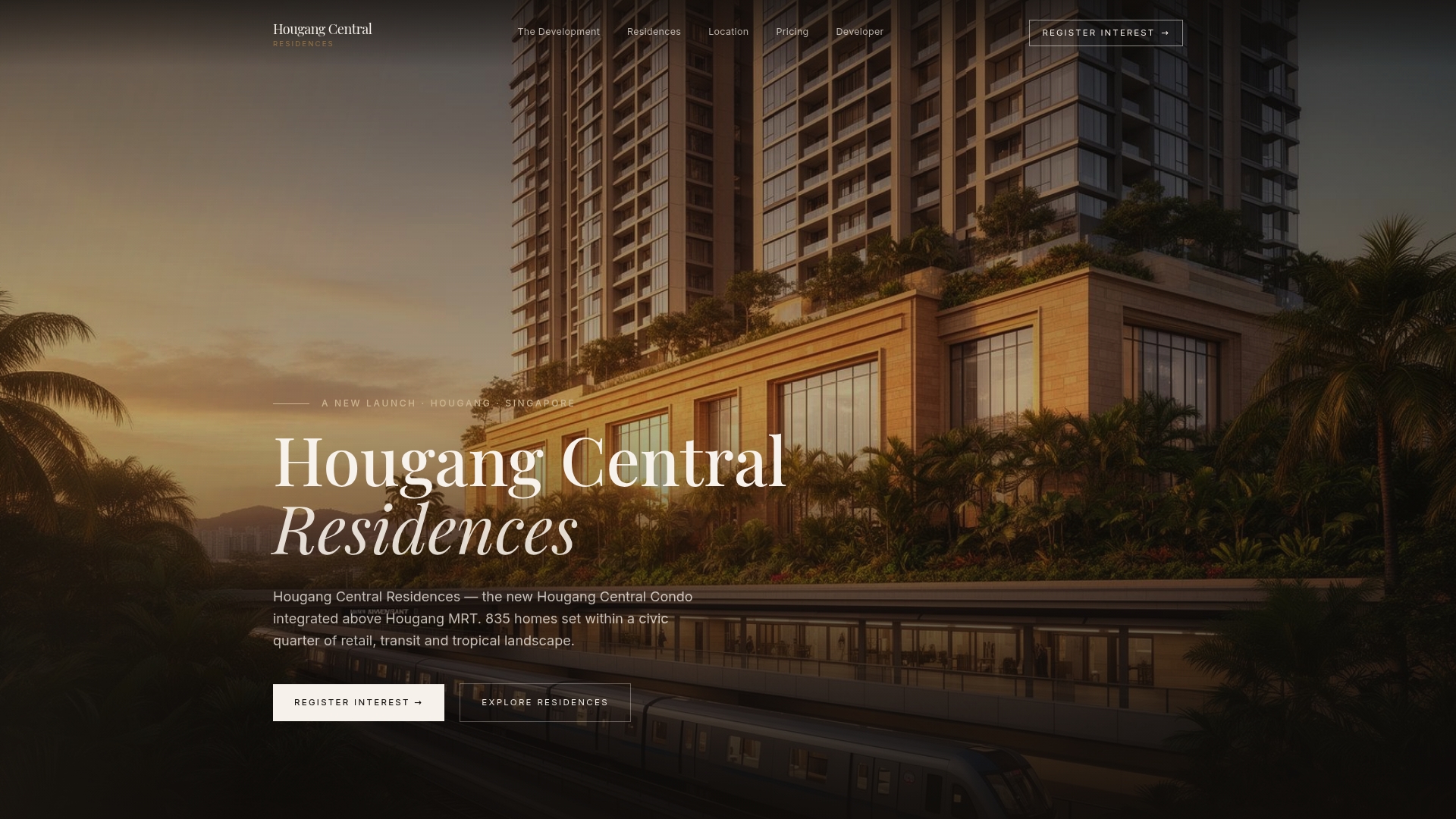
If you are comparing layouts and thinking about how you would light each room, register for a showflat visit through our website and see the spaces for yourself.
FAQ
Which is more efficient, LED or halogen?
LED is far more efficient. The NEA says LEDs use about 80 per cent less electricity than incandescent lighting, the family halogen belongs to. In practice, an 8–10W LED can match the brightness of a 42–50W halogen.
Are LED bulbs brighter than halogen bulbs?
Not automatically. Brightness depends on lumens, not on technology. An LED and a halogen with the same lumen rating are equally bright, but the LED draws much less power. Compare the lumen figure on the packaging instead of watts.
Can I put LED bulbs in halogen fittings?
Usually yes for 230V GU10 spotlights, where the bulb swaps directly. For 12V MR16 lamps on a transformer, check the transformer's minimum load, since a small LED load can flicker. Dimmer circuits need dimmable LEDs and a compatible dimmer. For wiring or driver changes, hire a licensed electrician.
When should you not use LED bulbs?
Be careful in sealed fittings not rated for LEDs, on old dimmers that are not LED-compatible, and with low-voltage transformers that need a minimum load. In those cases choose a bulb rated for the fitting, or have the circuit updated.
Sources
- NEA: Climate-Friendly Household Package
- NEA: Mandatory Energy Labelling Scheme and Minimum Energy Performance Standards
- REACH: Public consultation on lamp energy standards
- Energy Rating (Australia): Comparing lumens to watts
- European Commission: A Consumer's Guide to Energy-Efficient Lighting
- StoreySG: LED vs Halogen, Incandescent and CFL
- Houzz Singapore: A Lighting Pro's 5 Tips for Buying LED Bulbs
- FixFirst: LED vs Halogen vs CFL Singapore Light Bulb Guide
- CHINT Singapore: Consumer Guide to Understanding LED Light
- Replace Halogen Downlights with LED: GU10 and MR16
- Window Tinting vs Blinds