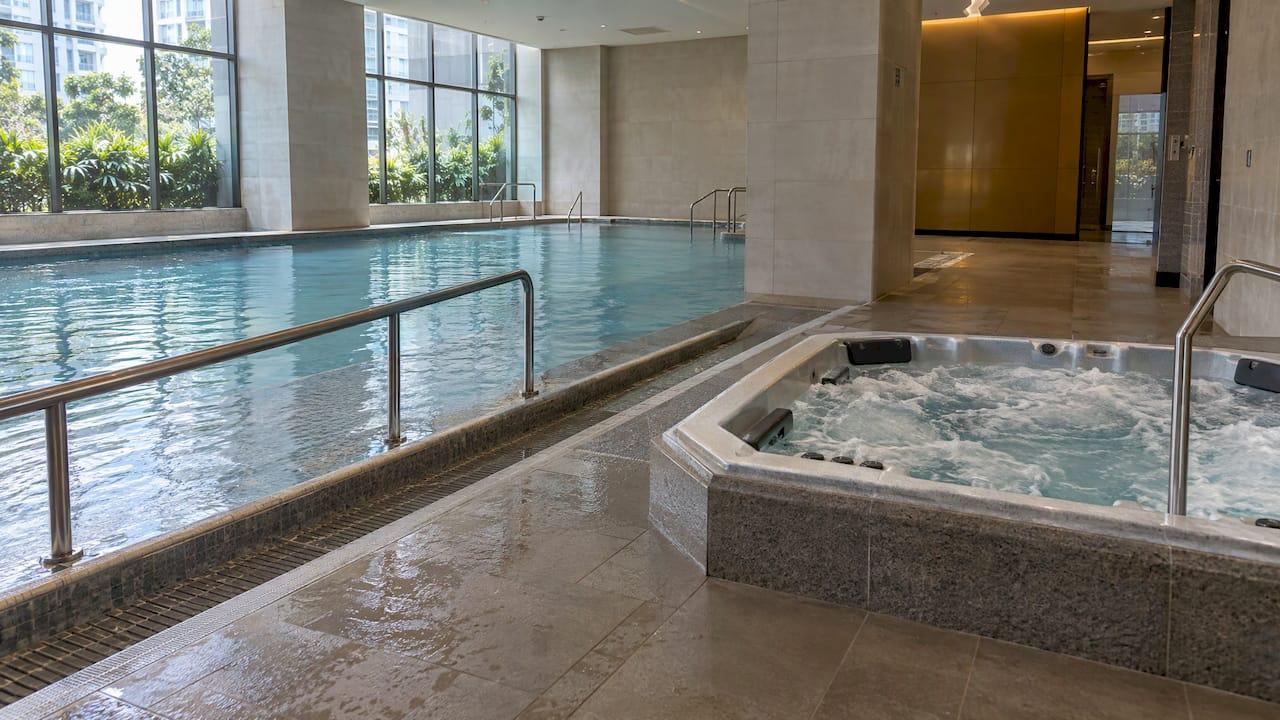
A hydrotherapy pool is a large, warm, shallow pool built for walking, floating and moving through water features. A Jacuzzi is a small jet-powered tub built for soaking. For a Singapore apartment owner, the practical answer is that the first belongs in a shared wellness facility and the second is the only one that can realistically fit inside a home. That is why we think the better route for most high-rise buyers is a residence with wellness facilities built in, such as Hougang Central Residences, rather than a private installation.
TL;DR
- A hydrotherapy pool is larger and typically 34°C to 40°C, with a depth of 1.0 m to 1.2 m. A Jacuzzi-style pool is smaller and typically 35°C to 38°C, according to the Hot Springs Association guide.
- Warm-water exercise has research support for knee osteoarthritis pain and function, and for people who find land exercise hard.
- In Singapore, NEA does not require an aquatic facility licence for a spa in a private house for own use, but water care and approvals still matter.
- Shared wellness facilities in a condo give you the soak without the plumbing, testing and structural questions.
Table of Contents
- What each one actually is
- Which one suits soaking, exercise or recovery
- What owning one means in a Singapore home
- Using warm water safely
- Why a shared wellness facility fits high-rise living
- Hougang Central Residences
- Our view
- FAQ
- Sources
What each one actually is
The two terms are often mixed up, so start with the definitions.
A hydrotherapy pool is a warm pool designed for movement. The Hot Springs Association's Hydrothermal Guide describes these as typically much larger, letting guests walk or float a course of water features at 34°C to 40°C, with a depth of 1.0 m to 1.2 m. They are usually found in hospitals, rehabilitation centres, some physiotherapy clinics and leisure complexes, and Arthritis Australia notes they generally have a ramp, hoist or gently sloping steps rather than a ladder.
A Jacuzzi is a brand name that has become a common word for a pool with water jets. The same guide calls the generic version a vitality pool: a mini-hydrotherapy experience for places where space will not allow a full-size hydrotherapy pool, running at 35°C to 38°C with underwater pressurised air and water features.

The whirlpool bathtub is a third thing. A 2026 industry report describes hydrotherapy pools as larger and able to hold several users at once, with constant-temperature circulation, filtration and sterilisation. Whirlpool bathtubs, it says, are closer to an upgraded bathtub, installed in home bathrooms, using a pump and nozzles to direct water for massage.
Side by side
| Hydrotherapy pool | Jacuzzi / vitality pool | |
|---|---|---|
| Typical size | Large, several users at once | Small, a few users |
| Typical temperature | 34°C to 40°C | 35°C to 38°C |
| Depth | 1.0 m to 1.2 m | Seated soaking |
| Main purpose | Walking, floating, guided movement | Relaxing, jet massage |
| Access | Ramps, hoists or gentle steps | Steps or built-in seating |
| Usual setting | Clinics, hospitals, leisure and wellness complexes | Homes, hotels, spa corners |
Hot tubs sit close to the Jacuzzi column. BISHTA, the UK trade body, says hot tubs are heated to between 30°C and 40°C and use hydrotherapy jet circulation.
Which one suits soaking, exercise or recovery
The choice follows what you want to do in the water.
For relaxing after work, a Jacuzzi-style soak is enough. Warm water and jets loosen muscles, and a small footprint is the point. It is a place to sit, not to train.
For movement and joint comfort, the larger hydrotherapy format matters because you can stand and walk in it. Arthritis Australia explains that in chest-deep water your legs support only about a third of your body weight, which is why many people with sore feet, knees, backs or hips move more freely in water than on land.
The research on warm-water exercise is encouraging, within clear limits:
- A 2017 randomised trial in older women with knee osteoarthritis found that hydrotherapy in a heated pool, twice a week for six weeks, improved pain and function compared with a control group.
- A 2011 meta-analysis found that aquatic exercise outcomes for adults with arthritis were comparable to land-based exercise, and that water programs are a useful alternative when land exercise is difficult.
- A 2010 review found small but statistically significant effects of aquatic exercise on pain in conditions such as arthritis and low back pain.
If you have a joint condition, heart condition, high blood pressure or are pregnant, ask your own doctor or physiotherapist how hot and how long before you start a warm-water routine. The programs in these studies were set for the participants, not for the general public.
What owning one means in a Singapore home
This is where the two diverge sharply for a flat or condo owner.
The rules
NEA's licensing portal classes a multi-use spa pool as an artificial pool that recirculates water through hydrojets or air-induced bubbles. It explicitly includes hydrotherapy pools, hot tubs, Jacuzzis and onsen pools. A licence is not required for such a facility in a private residential house intended for own use. That is a house, not a shared development, and it does not remove the need for safe water care or any other approval your project needs.
When a spa is licensed, the standards show how demanding the water is. NEA's licensing requirements set spa-pool free chlorine at 3 to 5 ppm, a pH of 7.2 to 7.8 for chlorine, and total bromine of 4 to 6 ppm where bromine is used. Testing is daily on site and monthly at an accredited laboratory, with Legionella testing quarterly for spa pools. A private owner is not bound by that licence, but it shows what a warm, recirculating tub needs to stay clean.
Space and structure
A hydrotherapy pool of the size used in clinics and wellness centres is a building project. A Jacuzzi is smaller, yet a water-filled tub on a balcony or roof terrace still raises questions about floor loading, waterproofing, drainage and electrical supply. Industry commentary in the 2026 market report lists electrical safety, waterproofing, filtration and disinfection, installation and maintenance and after-sales service as what separates good products from poor ones. Those are the same questions you would carry as an owner.
Liability
A private pool or spa also changes your risk profile. Before you commit, read how a home policy treats pool liability insurance coverage, because a standard policy may not cover everything you expect.
Using warm water safely
These points apply whether the tub is at home, in a hotel or in a condo facility.
- Time and heat. Long exposure to hot water can lead to dehydration or overheating. Keep sessions short, drink water, and get out if you feel dizzy.
- Never alone. King County Public Health advises that someone within calling distance should check on a bather regularly, and ideally nobody uses a hot tub alone.
- Water quality. The same guidance says not to enter a hot tub with a free chlorine residual below 1.0 ppm, because of the risk of catching or spreading infection.
- Groups to take care. Children, pregnant women, older adults and anyone with a heart or blood-pressure condition should check with a doctor first.
Why a shared wellness facility fits high-rise living
Put the facts together. Hydrotherapy pools need size and constant treatment. Jacuzzis need less space but still need plumbing, power, structural checks and routine water care. In a Singapore flat the practical question is not which to install, but how to get the benefit without taking on the project.
A development with wellness and social facilities answers that. You use the facility, and the development's operators handle the infrastructure. It is also a better fit for different life stages. Families can use a shared space together, young professionals can unwind after a commute, and retirees can find a community around regular activity.
This is what we designed Hougang Central Residences around. It has 835 residences above Hougang MRT station, ranging from 1-bedroom plus study to 5-bedroom penthouses, integrated with a retail mall and bus interchange. The project includes wellness and social facilities and tropical landscaped communal spaces, so recovery and relaxation sit a lift ride from home.

Hougang Central Residences
If you are weighing a private soak against a home that already has shared wellness space, start with the units. The residences page lists the 1-bedroom plus study through to the 5-bedroom penthouse, and the pricing page shows pricing from S$2,800 per sq ft. Each home has premium European fittings and smart-home systems, and the project has direct MRT access, including the future Cross Island Line interchange.

Register for a showflat to see the facilities and layouts in person.
Our view
Most people who ask us about hydrotherapy pools and Jacuzzis are really asking how to make home a place where they can recover. The tub is the smaller part of that.
A private spa in a high-rise means weight, water, electricity and daily upkeep, all of which become your job. A home with shared wellness facilities hands that to a managed development, and lets you spend the time in the water instead.
That is why we put the wellness and social facilities, the landscaped communal spaces and the transit link together in one address. A short soak, a walk through the gardens and a ten-minute trip to the train belong in the same day, and Hougang Central Residences is built to make that day easy.
Simon
FAQ
What are the key differences between a hydrotherapy pool and a Jacuzzi?
A hydrotherapy pool is larger and shallow enough to walk in, at typically 34°C to 40°C with a depth of 1.0 m to 1.2 m. A Jacuzzi, or vitality pool, is smaller and typically 35°C to 38°C, with jets for soaking. The first suits movement, the second relaxation.
How many times a week should you do hydrotherapy?
There is no single number. The 2017 trial in older women with knee osteoarthritis used two sessions a week for six weeks. Your doctor or physiotherapist should set the frequency and length for your own condition.
Do I need an NEA licence for a Jacuzzi at home?
NEA says no licence is required for such a facility in a private residential house for own use. That does not remove the need for safe water care, and flats and shared developments have their own rules, so check with your management before any installation.
Is a Jacuzzi safe for everyone?
Not without precautions. Long soaks can cause dehydration or overheating, so keep sessions short and drink water. Pregnant women, children, older adults and people with heart or blood-pressure conditions should speak to a doctor first, and nobody should soak alone.
Sources
- Hydrothermal Spa & Wellness Guide, Hot Springs Association
- Water Exercise for Arthritis, Arthritis Australia
- Global Hydrotherapy Pools and Whirlpool Baths report, Market Publishers
- Buyers Guide for Hot Tubs and Swim Spas, BISHTA
- Hydrotherapy improves pain and function in older women with knee osteoarthritis, PMC
- Land and aquatic exercise meta-analysis, PMC
- Effectiveness of Aquatic Exercise and Balneotherapy, PMC
- Aquatic Facility Licence, NEA via GoBusiness
- Licensing requirements, NEA
- Staying Happy and Healthy in Your Spa & Hot Tub, King County Public Health
- Pool Liability Insurance: What Your Home Policy Covers