
TL;DR:
- European fittings in premium condos feature solid brass construction, frameless cabinetry, and tilt and turn windows that enhance value. They exemplify engineering quality, efficiency, and minimalist design crucial for luxury living and resale. Buyers should verify product standards and compatibility to ensure true European specification.
European fittings in premium condos are defined by precision engineering, minimalist form, and materials built to last decades. The term covers a broad category of fixtures and finishes, from bathroom taps by Hansgrohe and Grohe to frameless cabinetry, tilt and turn windows, and handcrafted architectural hardware. These are not decorative choices. They are functional systems that affect energy use, maintenance costs, and long-term resale value. The examples of European fittings in premium condos covered here represent the standard that serious homebuyers and real estate investors use to evaluate a property before signing.
1. What are examples of European fittings in premium condos?
European fittings is an industry shorthand for fixtures, hardware, and built-in systems that originate from or follow the design and engineering standards of European manufacturers. The recognized industry term is "European-specification fittings," which covers plumbing fixtures, cabinetry systems, window mechanisms, and architectural hardware. These products share three traits: tight manufacturing tolerances, restrained visual profiles, and compliance with European efficiency standards. Brands like Hansgrohe and Grohe are the most cited benchmarks in this category, and their products appear in premium developments across Singapore, London, and Dubai.
The distinction matters for investors. A condo marketed as having "European fittings" carries a specific promise about material quality and design philosophy. Buyers who understand what that promise includes are better positioned to assess whether a development delivers real value.
2. Premium bathroom fittings: the clearest mark of luxury
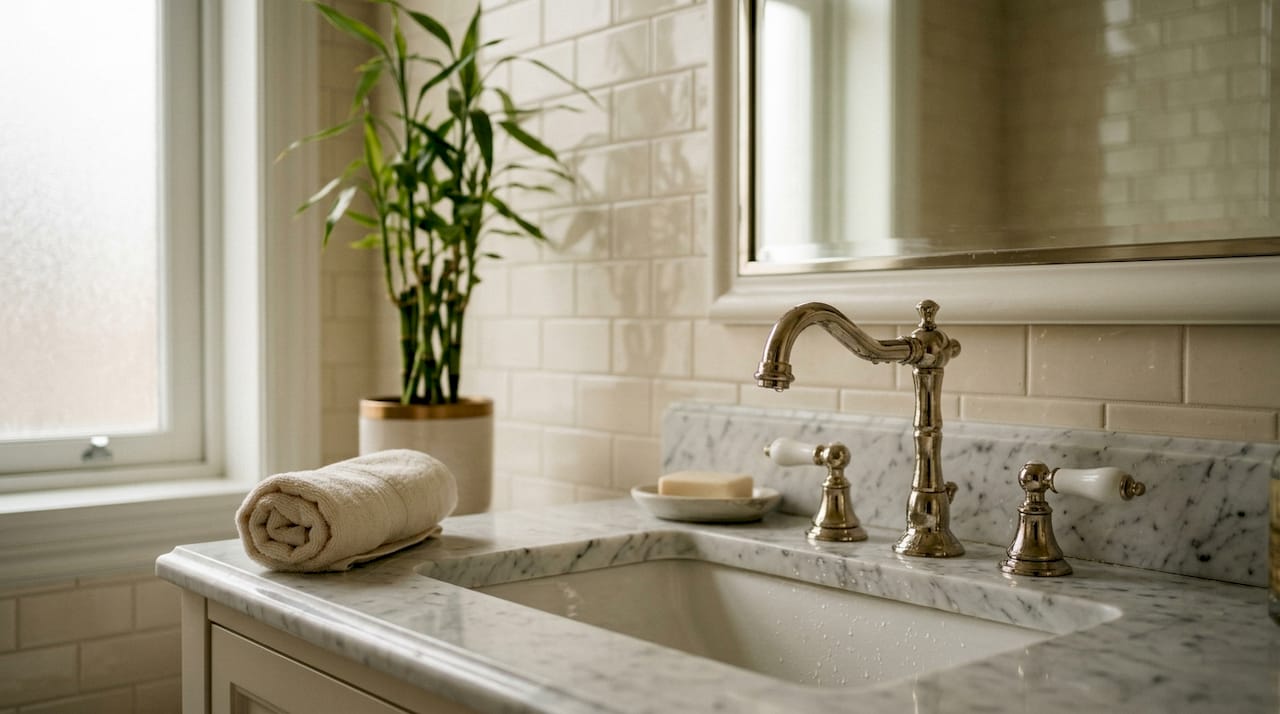
Bathroom fixtures are the most visible and most evaluated category of European fittings in high-end condos. Premium bathroom taps in Europe typically range from €1,500 to €4,500, with PVD (Physical Vapor Deposition) finishes adding a 20–40% price premium over standard chrome. That price range signals a specific level of engineering, not just aesthetics.
The core construction standard for this tier is solid brass bodies paired with ceramic disc valves. Fixtures handcrafted from solid brass with ceramic disc valves are built for longevity across generations. Ceramic discs eliminate the rubber washer failures common in lower-grade taps, which means no dripping and no replacement cycles for 20-plus years.
Eco-efficiency is built into the specification. Standard basin flow rates for top-tier European taps run at 5–5.7 liters per minute, which meets European water efficiency targets without sacrificing pressure feel. For a condo with 835 units like Hougang-central-residences, that flow rate standard across all bathrooms represents a meaningful reduction in building-wide water consumption.
Pro Tip: When evaluating a premium condo's bathroom spec sheet, ask specifically for the tap model number. A genuine European-spec tap will have a verifiable product listing with a published flow rate and valve type. Generic "European-style" taps without model numbers are a red flag.
The segmentation of bathroom accessories by price tier tells you a lot about a developer's commitment:
- Basic accessories ($280–$600): Decorative only, limited engineering specification
- Standard faucets ($800–$1,200): Functional quality, mid-tier materials
- Architectural focal points ($1,500–$2,000+): Full European specification, solid brass, PVD or brushed finishes, ceramic valves
Developers who invest at the top tier signal that the rest of the build quality follows the same standard.
3. Frameless European cabinetry: space and clean lines
Frameless cabinetry, also called euro-style or full-access cabinetry, is the dominant cabinet construction method in European premium condos. The defining difference from American framed cabinets is structural. Framed cabinets attach doors to a face frame that reduces the opening width. Frameless cabinets attach doors directly to the box, which increases usable storage by about 1 inch per cabinet opening. In a compact urban condo, that gain compounds across every kitchen and bathroom cabinet in the unit.
The visual result is a flat, uninterrupted facade with no visible frame lines. Frameless cabinetry's clean facade also reduces dust collection points, which is a practical benefit in tropical climates like Singapore's. The modular interior system allows for custom drawer configurations, pull-out organizers, and integrated lighting without structural modification.
| Feature | Frameless (European) | Framed (Traditional) |
|---|---|---|
| Opening width | Full box width | Reduced by face frame |
| Facade appearance | Flat, uninterrupted | Visible frame lines |
| Dust collection | Minimal | Higher at frame joints |
| Interior flexibility | High, modular | Limited by frame |
| Typical condo context | Premium urban developments | Mid-range and traditional builds |
Materials in this tier run from high-gloss lacquered MDF to matte thermofoil and real wood veneer. The finish choice affects both price and maintenance. High-gloss shows fingerprints; matte thermofoil resists moisture better in humid environments.
Pro Tip: Ask the developer for the cabinet box material specification, not just the door finish. A European-spec frameless cabinet uses a minimum 18mm thick box panel. Thinner panels flex over time and compromise drawer alignment.
4. European tilt and turn windows: engineering that earns its price
Tilt and turn windows are the standard window type in premium European residential construction, and they are increasingly specified in high-end condos across Asia and the Middle East. The mechanism operates on two axes. Turned fully, the sash swings inward like a casement door. Tilted at the top, it opens a narrow gap for ventilation while keeping the lower sash sealed.
Tilt and turn windows provide airtight seals, multi-point locking across the full perimeter of the frame, and the ability for one person to clean both glass faces from inside the unit. That last point is significant in high-rise condos where exterior window cleaning is either expensive or impossible for residents.
The security benefit is concrete. Multi-point locking engages at four or more points around the frame simultaneously, compared to the single-point latch on most sliding windows. For a premium condo on upper floors, this is a meaningful upgrade in both security and acoustic performance.
The trade-off is window treatment cost. Custom European blinds are necessary for tilt and turn windows because standard blinds cannot accommodate the inward-opening sash. These specialized blinds require exact measurements and non-invasive attachment systems that move with the window. They typically cost around 2% of home value, more than standard window coverings.
Key advantages for premium condo buyers:
- Airtight seal reduces both heat transfer and external noise
- Multi-point locking provides higher security than single-latch alternatives
- Interior cleaning access eliminates the need for exterior window services
- Tilt ventilation mode allows airflow without full exposure or security risk
- Architectural profile maintains clean exterior facade lines
5. Architectural hardware and accessories: the details that unify a design
Architectural hardware is the category most buyers overlook and most developers use to differentiate a premium build from a mid-range one. Door levers, cabinet pulls, bathroom accessories, and mirrors are the tactile layer of a condo's interior. When they are specified at a European standard, they carry the same engineering logic as the plumbing fixtures.
Handcrafted levers from makers like Joseph Giles are constructed from solid brass and finished by hand. The weight and action of a solid brass lever communicates quality at every use. These are not decorative pieces. They are mechanical components with a defined lifespan and a consistent feel that cheaper zinc alloy alternatives cannot replicate.
The procurement process for this tier of hardware has a practical implication for buyers and developers. Architectural hardware samples often require full upfront payment, refundable only on timely and complete return of the products. That policy affects cash flow during the specification phase and signals the exclusivity of the product tier.
Selecting cohesive hardware across a residence matters for two reasons:
- Design unity: Mismatched finishes across rooms read as incomplete, regardless of individual piece quality.
- Resale value: Buyers at the premium tier notice hardware consistency. A unified specification signals developer attention to detail.
- Installation compatibility: European hardware uses metric thread standards. Mixing European and non-European hardware in the same installation can require adapters or custom drilling.
- Longevity: Solid brass hardware outlasts zinc alloy by decades. The upfront cost difference disappears over a 20-year ownership period.
Italian luxury bathroom fixtures represent a specific sub-category that fuses engineering precision with clear aesthetic intent. Italian-made mirrors, towel rails, and soap dispensers from this tier are designed as a system, not as individual pieces, which is why they read as coherent in a finished space.
6. European design philosophy: why lightness matters
European design favors thin profiles like floating vanities and concealed plumbing to create airy, minimalist bathrooms. This contrasts directly with the heavier, more solid aesthetic common in North American residential construction. The practical effect is that European-fitted condos feel larger than their square footage suggests.
European fittings' visual lightness creates sanctuary-like spaces preferred by luxury condo buyers. That preference is not purely aesthetic. Concealed plumbing reduces maintenance access points and creates cleaner wall surfaces. Floating vanities make floor cleaning faster and visually extend the floor plane.
For investors, this design philosophy has a direct market implication. Premium condo buyers in Singapore, London, and Dubai consistently prioritize this aesthetic in their shortlists. A development that delivers it authentically commands a price premium at resale.
Key takeaways
European fittings in premium condos are defined by solid brass construction, ceramic disc valves, frameless cabinetry systems, tilt and turn window mechanisms, and cohesive architectural hardware, all selected for engineering quality and long-term resale value.
| Point | Details |
|---|---|
| Bathroom fittings set the standard | Top-tier European taps use solid brass and ceramic disc valves, priced from €1,500 to €4,500. |
| Frameless cabinetry gains real space | Euro-style cabinets add about 1 inch of usable storage per opening versus framed alternatives. |
| Tilt and turn windows add security | Multi-point locking and interior cleaning access justify the higher window treatment cost. |
| Hardware cohesion affects resale | Unified European hardware finishes signal quality and command premium pricing at resale. |
| Plumbing compatibility requires verification | NPT versus BSP thread differences between European and local plumbing standards can require adapters. |
Why I think most buyers underestimate hardware
Most buyers focus on the bathroom tap brand and the kitchen cabinet finish. Those are the right categories to evaluate, but the hardware layer is where premium condos actually separate from mid-range ones. I have walked through developments where the plumbing fixtures were genuinely European-spec, but the door levers were zinc alloy with a brushed nickel spray finish. That combination tells you the developer cut costs at the end of the build, which usually means other late-stage decisions were also compromised.
The other thing buyers consistently miss is plumbing compatibility. Importing European fittings requires verifying whether the local plumbing uses NPT (National Pipe Thread) or BSP (British Standard Pipe) standards. A mismatch means adapters at minimum, and re-plumbing at worst. Consulting a local plumber before ordering is the step that saves the most money in this process.
My honest view is that the floating vanity and concealed plumbing specification is the single best indicator of a developer's commitment to European design principles. It costs more to install and requires more precise rough-in work. Developers who do it correctly are signaling that the rest of the build followed the same discipline.
— Simon
Hougang-central-residences: European fittings in a transit-connected condo
Hougang-central-residences applies the European fittings standard across its 835 residences, from 1-bedroom units to 5-bedroom homes above Hougang MRT station in Singapore.

The development specifies frameless European cabinetry throughout, which maximizes storage in every unit size and delivers the clean facade that premium buyers expect. The integration of smart-home systems alongside European-specification fixtures positions Hougang-central-residences as a development where design quality and daily convenience operate together. Buyers and investors who want to see these premium condo features in person can explore available units directly on the Hougang-central-residences website.
FAQ
What are European fittings in a condo?
European fittings are fixtures, hardware, and built-in systems that meet European engineering and design standards. They include solid brass bathroom taps, frameless cabinetry, tilt and turn windows, and handcrafted architectural hardware.
Why are European fittings preferred in premium condos?
European fittings combine precision construction, eco-efficient performance, and minimalist aesthetics that increase both livability and resale value. Developers use them to signal build quality and attract buyers at the top of the market.
How much do premium European bathroom taps cost?
Premium European bathroom taps typically range from €1,500 to €4,500, with PVD finishes adding a 20–40% premium over standard chrome options.
What is the difference between frameless and framed cabinetry?
Frameless cabinets attach doors directly to the box, gaining about 1 inch of usable opening width per cabinet compared to framed alternatives. They also present a flat, uninterrupted facade that suits minimalist condo interiors.
Do European fittings require special installation considerations?
Yes. European plumbing fittings use BSP thread standards, which differ from the NPT standard common in North America. Buyers importing European fixtures should verify compatibility with local plumbing before ordering to avoid adapter costs or re-plumbing work.